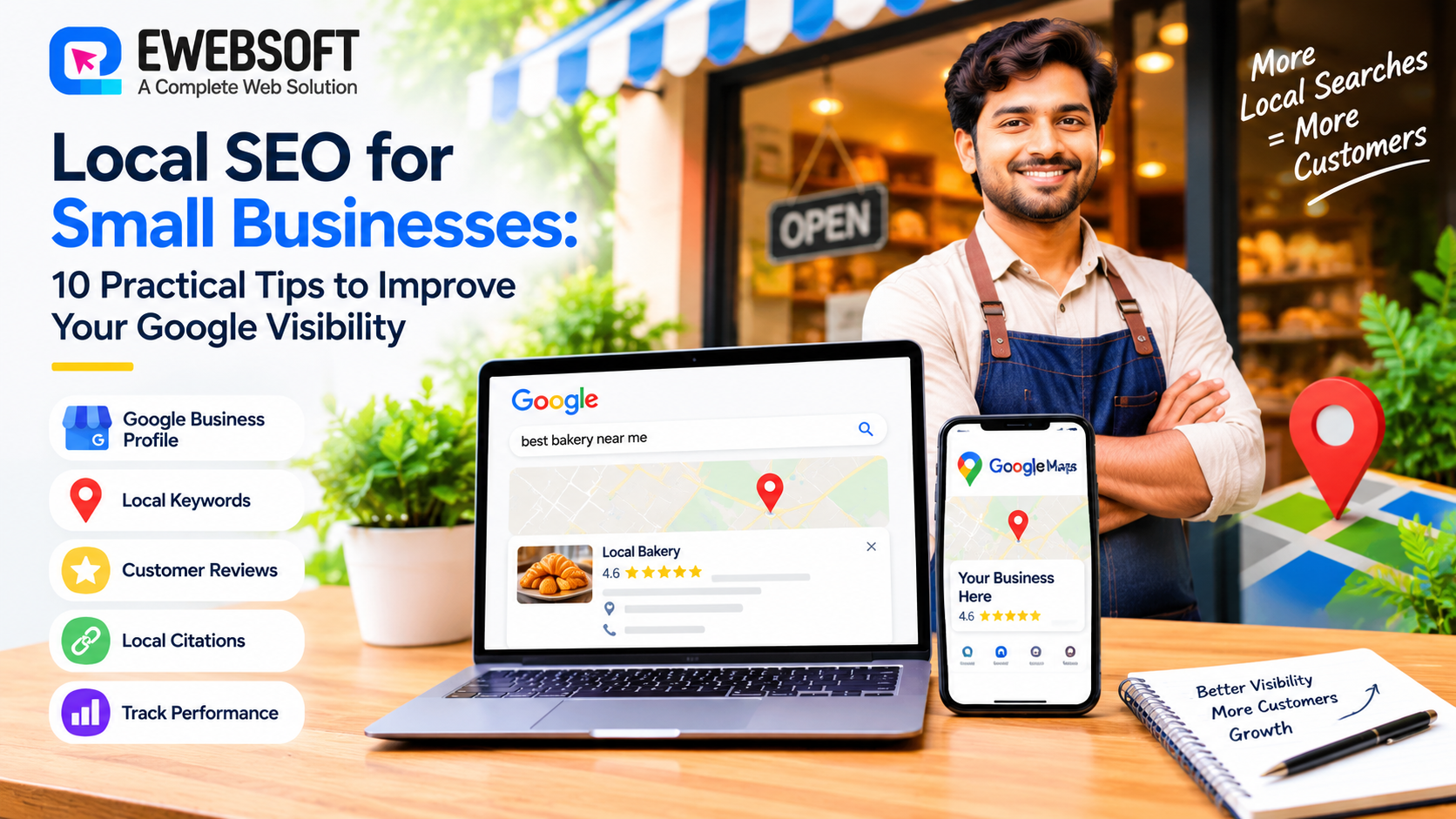
Local customers often search online before visiting a shop, booking a service, or contacting a nearby business. Whether someone needs a restaurant, real estate consultant, digital marketing agency, clinic, repair service, or retail store, Google Search and Google Maps can help them discover relevant local businesses.
However, simply creating a website or registering a business on Google does not guarantee visibility. Businesses need a consistent local SEO strategy that makes their services, location, and business information easy to understand.
Local SEO helps businesses improve their visibility in location-based searches and connect with people who are actively looking for products or services in their area.In this guide, we will explore 10 practical ways small businesses in India can improve their local search presence and attract more relevant enquiries.
What Is Local SEO?
Local SEO (Local Search Engine Optimisation) is the process of improving a business's online presence so that it can be discovered by people searching for products or services in a specific geographical area.For example, someone searching for:
- Best dentist in Dwarka
- Digital marketing agency in Delhi
- 2 BHK flats in Uttam Nagar
- Website development company near me
- Best restaurant in Noida
is expressing local search intent.
Google may display relevant business profiles, map results, websites, and other local information depending on the search query and location.
A well-planned Local SEO strategy helps businesses become easier to discover when potential customers search for relevant services.
10 Practical Ways to Improve Local SEO
1. Create and Optimise Your Google Business Profile
A Google Business Profile is an important starting point for businesses that serve customers at a physical location or within a defined service area.Make sure your profile contains accurate and complete information, including:
- Correct business name
- Appropriate primary and secondary categories
- Business address or service area
- Contact number
- Website URL
- Business hours
- Services and business description
- Relevant photographs
Choose categories that accurately describe what your business does. Avoid adding unrelated keywords to your business name or selecting categories simply because they appear popular.
Review your profile periodically to ensure that the information remains accurate.
2. Keep Your Business Information Consistent
Your business information should be consistent across your website, Google Business Profile, and relevant online directories.Pay particular attention to NAP details:
- Name
- Address
- Phone number
For example, if your business uses one phone number on its website and a different number on business directories, customers may become confused.
Check your existing listings on relevant platforms such as Justdial, Sulekha, and IndiaMART, where appropriate for your industry.
Correct outdated information and remove duplicate or misleading listings where possible.
Consistency makes it easier for customers to identify the correct business.
3. Target Location-Specific Keywords
Keyword research helps identify the phrases potential customers use when looking for local services.Instead of targeting only broad keywords, consider search terms that combine your service with a city, neighbourhood, or service area.
Examples:
| eneral keyword | Location-specific keyword |
|---|---|
| SEO services | SEO services in Delhi |
| Website development | Website development in Dwarka |
| Real estate | Flats in Uttam Nagar |
| Digital marketing | Digital marketing agency in Noida |
|Use relevant location-specific phrases naturally in page titles, headings, service descriptions, and website content.
Avoid repeating the same keyword excessively. Your content should remain useful and readable.
4. Create Dedicated Local Service Pages
If your business serves multiple locations, consider creating dedicated landing pages for important service areas.For example, a website development company serving Delhi NCR might create useful pages for Delhi, Noida, and Gurugram.
Each page should contain genuinely relevant information, such as:
- Services available in that location
- Local customer requirements
- Relevant projects or experience
- Contact information
- Frequently asked questions
- Useful local information
Do not create dozens of nearly identical pages by simply changing city names. Each page should offer meaningful value to visitors.
5. Encourage Genuine Customer Reviews
Customer reviews help potential customers understand the experiences of others before choosing a business.Encourage satisfied customers to share honest feedback through your Google Business Profile.
Some practical ways to request reviews include:
- Sending customers a review link after completing a project.
- Sharing a QR code at your business location.
- Including a review request in a follow-up message.
- Politely asking customers for feedback after a successful service experience.
Respond professionally to both positive and negative reviews.
Never purchase fake reviews, offer incentives in exchange for positive reviews, or pressure customers to leave favourable feedback.
Authentic customer experiences are more valuable than artificially increasing review numbers.
6. Publish Useful Local Content
Content marketing can support your Local SEO strategy by answering questions that matter to customers in your service areas.For example:
A real estate business in Delhi could publish articles about property documentation, neighbourhood facilities, home-buying considerations, and local market information.
A digital marketing agency could publish guides about improving online visibility for small businesses in Delhi NCR.
Useful local content ideas include:
- Local industry guides
- Frequently asked customer questions
- Service-related educational articles
- Neighbourhood guides
- Local business case studies
- Practical how-to articles
Focus on original information and genuine local relevance rather than publishing articles solely to include location keywords.
7. Make Your Website Mobile-Friendly and Fast
Many customers use smartphones to find nearby businesses, compare services, and contact providers.Your website should therefore work smoothly on mobile devices.
Check the following:
- Responsive page layouts
- Readable text
- Easy-to-use navigation
- Fast-loading images
- Clickable phone numbers
- Working contact forms
- Clear service information
Also monitor website performance using tools such as Google PageSpeed Insights and Google Search Console.
A technically sound website makes it easier for visitors to find information and contact your business.
8. Add Appropriate Local Business Structured Data
Structured data helps search engines understand specific information about a website.Depending on your business, relevant Schema.org structured data may include LocalBusiness or a more specific business subtype.
You can use structured data to describe information such as:
- Business name
- Address
- Telephone number
- Website
- Opening hours
- Relevant business details
Make sure the structured data accurately reflects information visible on your website.
Do not add inaccurate addresses, ratings, reviews, or business details simply to influence search results.
After implementation, use Google's Rich Results Test and monitor relevant Search Console reports.
9. Build Relevant Local Citations and Relationships
Local citations are online mentions of your business information, particularly its name, address, and phone number.Relevant business directories, industry associations, local organisations, and professional networks may help customers discover your business.
Prioritise platforms that are relevant to your industry and location.
You can also build local relationships through:
- Genuine partnerships with complementary businesses
- Local business events
- Industry contributions
- Community initiatives
- Relevant guest articles
- Professional associations
Avoid bulk directory submissions, paid link schemes, and irrelevant backlink exchanges.
The goal should be to build genuine business visibility rather than simply increasing the number of links.
10. Monitor Local SEO Performance Regularly
Local SEO requires regular monitoring because customer behaviour, competition, business information, and website performance can change over time.Use Google Search Console to understand how your website performs in Google Search.
Important metrics include:
- Search impressions
- Organic clicks
- Click-through rate
- Average search position
- Queries bringing visitors to your website
- Pages receiving organic traffic
Google Business Profile performance information can also help you understand how customers discover and interact with your business.
Track meaningful actions such as phone calls, website visits, direction requests, and enquiries where the available reporting supports them.
Use these insights to identify areas that need improvement.
A Simple 30-Day Local SEO Action Plan
Small businesses do not need to implement everything in one day. A structured approach makes the work easier to manage.| Timeline | Recommended activities |
|---|---|
| Week 1 | Review Google Business Profile and correct business information |
| Week 2 | Research local keywords and improve important website pages |
| Week 3 | Publish useful local content and review relevant business listings |
| Week 4 | Check website performance, review customer feedback, and analyse SEO data |
Continue monitoring results and improving your strategy based on actual performance.
For a more detailed implementation reference, read this practical Local SEO checklist for small businesses published by SyncNeck.
Common Local SEO Mistakes to Avoid
Even businesses that actively work on SEO can make mistakes that limit their online visibility.Avoid these common problems:
1. Using incorrect or outdated business information.
2. Creating duplicate Google Business Profiles.
3. Adding unnecessary keywords to the business name.
4. Publishing duplicate location pages.
5. Purchasing fake reviews or low-quality backlinks.
6. Ignoring mobile website performance.
7. Leaving customer reviews unanswered.
8. Publishing content without useful information.
9. Creating irrelevant directory listings.
10. Expecting immediate ranking improvements.
A sustainable Local SEO strategy focuses on accuracy, usefulness, relevance, and a good customer experience.
Conclusion
Local SEO is an important part of online growth for small businesses that want to reach customers in specific locations.By maintaining an accurate Google Business Profile, using relevant local keywords, improving website performance, publishing useful content, encouraging genuine reviews, and monitoring results, businesses can strengthen their local online presence.
Remember that Local SEO is an ongoing process. Results depend on factors such as competition, location, website quality, business relevance, and customer behaviour. There are no guaranteed rankings or fixed timelines.
Start with the basics, improve your online information consistently, and focus on helping potential customers find the right information about your business.
If your business needs help with website optimisation, local search visibility, or a broader digital marketing strategy, Ewebsoft can help you identify practical opportunities and plan the next steps.
Explore Ewebsoft's digital marketing and Local SEO solutions to strengthen your business's online presence.